In Brief | June 2026
Four Weeks in UK Leadership, Business and Retail: Resilience, Reluctance and a Great Deal of Weather
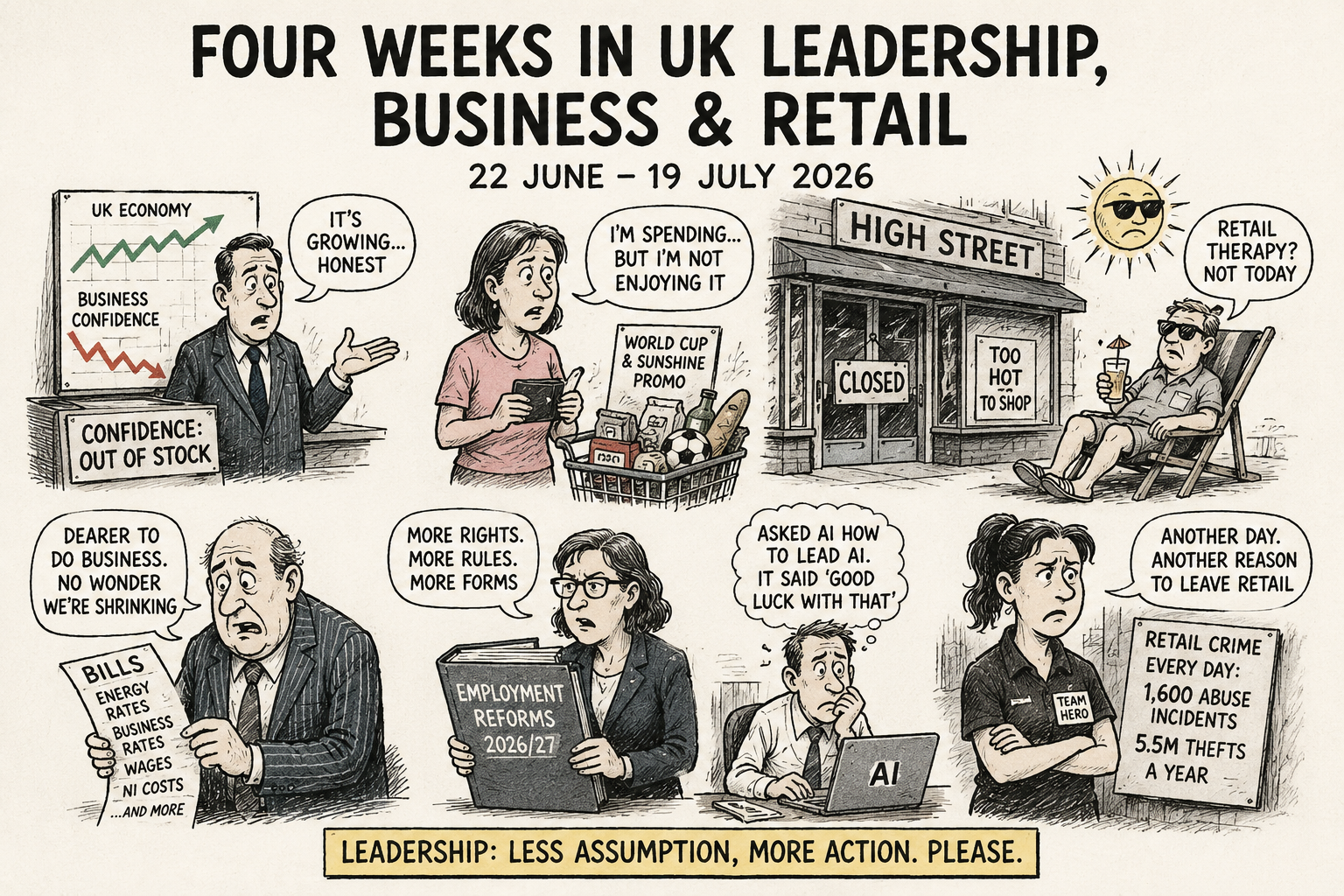
The past four weeks have delivered a curiously British business picture: modest economic resilience, deeply cautious sentiment, encouraging retail sales and fewer people actually visiting shops. Add rapidly evolving employment regulation, mounting pressure on entry-level jobs, artificial intelligence racing ahead of management capability and a record-breaking heatwave, and leaders have plenty to consider. The central question is whether organisations are managing temporary disruption—or adapting quickly enough to structural change.
Economic performance is stronger than business confidence
The UK economy grew by 0.7% in the three months to May, its sixth consecutive period of three-month growth, with services remaining the principal engine. Monthly GDP edged up by 0.1% in May following a 0.1% contraction in April. Yet business sentiment tells a notably gloomier story: the Institute of Directors’ Economic Confidence Index fell from -53 in May to -61 in June, while confidence in directors’ own organisations dropped from +23 to just +7. Revenue, investment and recruitment expectations also weakened. The economy, in other words, appears to be performing rather better than its managers feel about it. Leadership question: are cautious forecasts protecting the organisation—or causing it to underinvest while competitors continue moving?
Consumers are spending—but without feeling particularly cheerful about it
UK consumer confidence remained at -23 in June, indicating that households continue to feel decidedly uneasy about the wider economic outlook. Nevertheless, retail spending grew: total UK retail sales increased by 1.9% year on year during the five weeks to 4 July. This suggests consumers have not stopped spending, but are making more deliberate choices about when, where and on what. Promotions, seasonal demand, major events and immediate needs are proving more persuasive than general optimism. Leadership question: does your customer proposition rely on consumers feeling confident, or does it give them a sufficiently compelling reason to buy despite their uncertainty?
Retail growth disguised a widening divide between stores and online
The headline retail figure conceals an important channel shift. In-store non-food sales fell by 1.1% year on year in June, while online non-food sales grew by 5.1%. Online accounted for 39% of non-food sales, its highest penetration rate of 2026. Some of this was undoubtedly weather-related, but retailers should resist dismissing it as merely a hot month and an enthusiastic national search for electric fans. Digital convenience becomes especially powerful whenever visiting a store feels inconvenient. Leadership question: is your store estate offering an experience valuable enough to overcome the convenience advantage of online—or is it still operating primarily as a more expensive distribution channel?
Extreme weather is now an operating condition, not an occasional inconvenience
UK retail footfall fell by 3.4% year on year in June as exceptional temperatures kept customers away. High streets experienced the sharpest decline, down 6.2%, while retail parks fell by only 0.3% and shopping centres by 2.5%. The variation matters: location, air conditioning, accessibility and the customer’s reason for visiting all affected resilience. Extreme weather also creates workforce, stock, refrigeration, logistics and colleague-welfare challenges. Seasonal planning based on averages is becoming increasingly unreliable. Leadership question: does your operating model include meaningful weather contingencies, or does the plan still assume that summer will behave itself?
The cost of doing business is becoming a strategic design problem
The pressure on smaller businesses and retailers is no longer attributable to a single cost line. Parliament’s Business and Trade Committee highlighted rising energy standing charges, business rates, wages and statutory employment costs, warning that their cumulative effect is restricting investment and recruitment. The British Retail Consortium estimates that employer National Insurance changes and above-inflation minimum-wage increases have added £6.5 billion to retail costs over two years, alongside 66,000 fewer retail jobs than a year earlier. Incremental cost-cutting alone is unlikely to solve a structurally more expensive operating environment. Leadership question: which activities genuinely create customer or commercial value—and which remain simply because the organisation has always paid for them?
Employment reform has moved from policy discussion to management execution
Government guidance updated in July confirms that changes introduced during 2026 include wider Statutory Sick Pay eligibility, day-one paternity and unpaid parental leave, stronger collective-redundancy protections, enhanced whistleblowing safeguards and new holiday-pay recordkeeping requirements. Further reforms will follow, including changes to unfair-dismissal protection from January 2027, while consultations remain open on zero-hours arrangements, workplace monitoring and holiday-pay enforcement. Compliance will require more than amended policies: frontline managers will need to understand how the rules affect everyday recruitment, scheduling, absence, performance and conduct decisions. Leadership question: are managers being trained to apply the new framework consistently, or is the organisation relying on an updated handbook that few people will read until something goes wrong?
AI adoption is becoming a test of leadership credibility
Recent Chartered Management Institute research found that only 12% of UK managers feel very confident leading teams that use AI, falling to 10% for more advanced agentic systems. At the same time, 70% of managers reported using generative AI for workplace advice and guidance. The irony is difficult to miss: managers are increasingly asking AI how to manage AI. The opportunity remains substantial, but technology investment without clear accountability, training, process redesign and human judgement risks producing faster activity rather than better performance. Leadership question: where is AI delivering a measurable improvement in customer value, productivity or decision quality—and where is the organisation merely accumulating licences and impressive demonstrations?
Retail crime is now a leadership, culture and customer-experience issue
The BRC’s new retail manifesto reports approximately 1,600 incidents of violence or abuse against retail workers each day and 5.5 million thefts annually. This cannot be treated solely as a loss-prevention calculation. Persistent crime affects colleague confidence, absence, retention, store standards and whether customers feel comfortable visiting a location. Leaders must balance accessibility and service with security, while ensuring colleagues are not tacitly expected to absorb unreasonable risk in defence of stock. Leadership question: do your safety procedures genuinely protect colleagues—or do they look reassuring on paper while leaving frontline teams to make difficult decisions alone?
What should leaders take from the month?
The most important message is that headline results are becoming less informative without context. Sales can rise while stores struggle; the economy can grow while confidence collapses; technology can save time without creating value; and employment protections can improve while opportunities to enter the workforce decline. Leaders should distinguish temporary influences from structural shifts, revisit assumptions about how customers and colleagues behave, and make investment decisions based on evidence rather than general mood. Uncertainty may justify caution—but it does not excuse organisational paralysis.